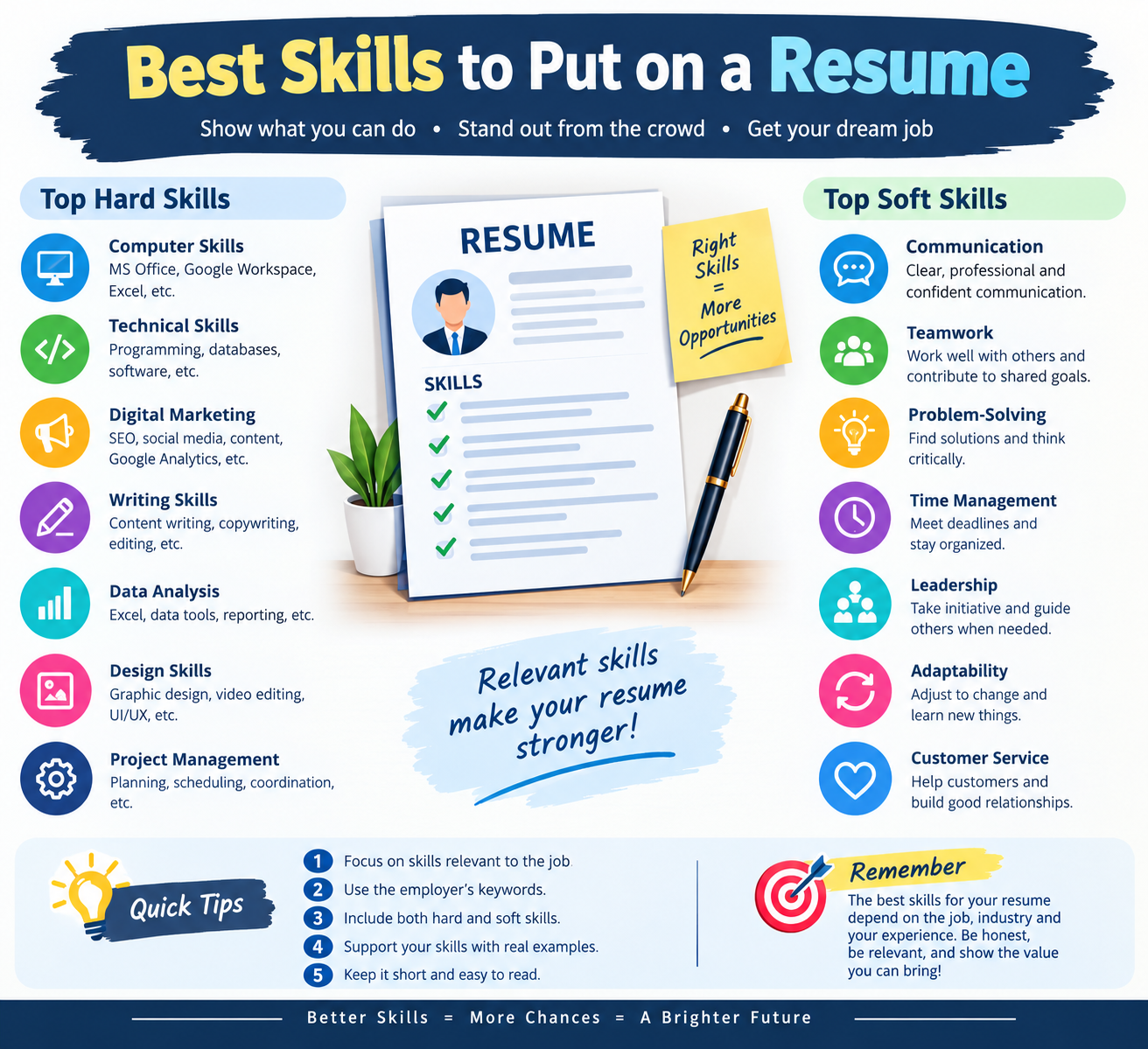
Your resume is often the first thing an employer sees, so choosing the right skills can make a big difference. A strong resume should show both your technical abilities and your personal strengths that match the job you want.
In this guide, we’ll look at the best skills to put on a resume and how to present them effectively.
Why Are Skills Important on a Resume?
Employers often scan resumes quickly to find skills that match their job requirements. Including relevant skills can help your resume stand out and may also help it pass through an Applicant Tracking System (ATS).
However, adding too many unrelated skills can make your resume less effective. Focus on skills that are relevant to the position.
1. Communication Skills
Communication is valuable in almost every career. Employers look for people who can communicate information clearly and professionally.
Examples include:
- Written communication
- Verbal communication
- Active listening
- Presentation skills
- Professional email writing
- Customer communication
2. Computer Skills
Basic computer skills are useful for many modern jobs.
Examples include:
- Microsoft Word
- Microsoft Excel
- Microsoft PowerPoint
- Google Workspace
- Email management
- Online collaboration tools
For technology-related positions, you can list more specialized skills such as programming, databases, or software development.
3. Digital Marketing
Digital marketing skills are useful for marketing, business, freelancing, and online careers.
Examples include:
- Search engine optimization (SEO)
- Social media marketing
- Content marketing
- Email marketing
- Google Analytics
- Keyword research
4. Problem-Solving
Employers value people who can identify problems and find practical solutions.
You can demonstrate problem-solving through examples of projects where you:
- Identified an issue
- Analyzed possible solutions
- Made a decision
- Improved a process
- Achieved a measurable result
5. Time Management
Good time management helps employees complete tasks and meet deadlines.
Useful skills include:
- Task prioritization
- Meeting deadlines
- Planning
- Organization
- Managing multiple tasks
6. Teamwork
Most workplaces require employees to work with other people. Teamwork skills show that you can cooperate and contribute to shared goals.
Examples include:
- Collaboration
- Conflict resolution
- Sharing responsibilities
- Supporting team members
- Giving and receiving feedback
7. Leadership
Leadership isn’t only for managers. It can also include taking responsibility, organizing projects, and helping others achieve goals.
Examples include:
- Team coordination
- Decision-making
- Delegation
- Project management
- Mentoring
8. Adaptability
Workplaces and technologies change quickly. Adaptability shows that you can learn and adjust when circumstances change.
You can demonstrate adaptability by mentioning:
- Learning new software
- Taking on new responsibilities
- Learning new skills
- Working in changing environments
9. Project Management
Project management skills can be valuable for many professional roles.
Examples include:
- Planning projects
- Setting deadlines
- Managing resources
- Tracking progress
- Coordinating teams
- Risk management
10. Customer Service
Customer service skills are particularly useful for retail, sales, support, hospitality, and many freelance roles.
Examples include:
- Customer communication
- Complaint handling
- Problem resolution
- Product knowledge
- Relationship building
11. Writing Skills
Strong writing can be valuable in many careers.
Depending on the position, you might include:
- Content writing
- Copywriting
- Technical writing
- Report writing
- Editing
- Proofreading
12. AI Skills
AI-related skills are becoming increasingly useful across many industries. Instead of simply writing “AI” on your resume, mention the specific tools or abilities you actually have.
Examples include:
- AI-assisted research
- AI content workflows
- Prompt writing
- AI productivity tools
- Data analysis with AI tools
- AI-assisted coding
Only list AI tools or skills you genuinely understand and can discuss in an interview.
Hard Skills vs. Soft Skills
A strong resume can include both hard skills and soft skills.
Hard skills are specific abilities that can often be learned and demonstrated, such as:
- Excel
- SEO
- Graphic design
- Programming
- Data analysis
- Video editing
Soft skills relate to how you work with people and manage tasks, such as:
- Communication
- Teamwork
- Adaptability
- Leadership
- Time management
- Problem-solving
The best combination depends on the job.
How to Choose the Right Skills
Don’t use the same skills section for every application. Read the job description carefully and identify the abilities the employer is asking for.
Then:
- Identify the most important requirements.
- Match them with skills you genuinely have.
- Use the employer’s terminology when it accurately describes your experience.
- Put your most relevant skills near the top.
- Support important skills with examples in your experience section.
For example, instead of simply writing:
“Communication skills”
you could demonstrate it through an experience bullet such as:
“Communicated with clients to understand project requirements and deliver work according to agreed deadlines.”
This provides evidence rather than simply naming the skill.
Common Resume Skills Mistakes to Avoid
Avoid these common mistakes:
- Listing skills you don’t actually have
- Adding too many unrelated skills
- Copying every keyword from a job description
- Using vague phrases without evidence
- Giving every skill the same level of importance
- Ignoring technical skills relevant to the position
Final Thoughts
The best skills for your resume depend on the job, industry, and your actual experience. Focus on relevant skills and support them with real examples whenever possible.
A well-written skills section should quickly tell an employer what you can do and why your abilities are relevant to the position.
Tip: Before submitting your resume, compare your skills with the job description and make sure your most relevant abilities are easy to find.
Leave a Reply