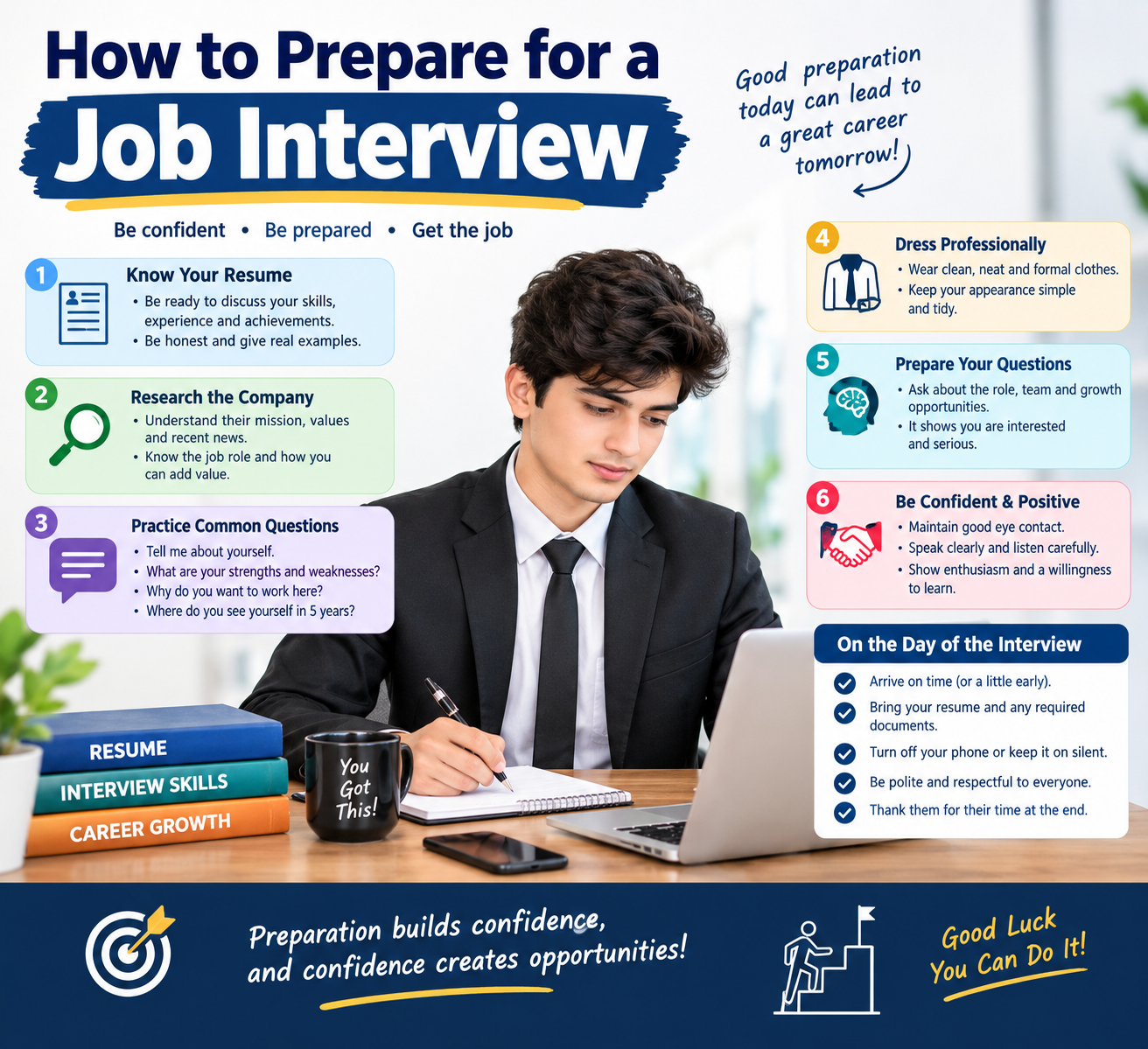
A Jobs interview can feel stressful, especially if it is your first one. The good news is that you can become much more confident by preparing in advance.
Whether you are applying for your first job, an internship, a remote position, or a new career opportunity, proper preparation can help you communicate your skills and experience clearly.
In this complete guide, you will learn how to prepare for a job interview, what to research, what questions to practice, what to wear, and what to do after the interview.learn more
What Is a Jobs Interview?
A job interview is a conversation between a job candidate and an employer. The employer uses the interview to learn more about your skills, experience, communication, and suitability for the position.
An interview also gives you an opportunity to learn more about the company and the job.
Interviews can take several forms, including:
- In-person interviews
- Phone interviews
- Video interviews
- Group interviews
- Technical interviews
- Panel interviews
- Online assessments followed by interviews
Why Is Interview Preparationnfor Jobs is Important?
Preparing for an interview can help you:
- Understand the company
- Learn more about the position
- Organize your experience and skills
- Answer common questions more confidently
- Prepare questions for the interviewer
- Reduce unnecessary stress
- Make a professional first impression
You do not need to memorize every possible answer. Instead, prepare your main points and practice explaining them naturally.
1. Read the Jobs Description Carefully
The first step is to understand exactly what the employer is looking for.
Read the job description and highlight:
- Required skills
- Preferred skills
- Education requirements
- Work experience
- Job responsibilities
- Technical requirements
- Soft skills
- Certifications
For example, if a job description says the company needs someone with communication, teamwork, and Microsoft Excel skills, prepare examples that demonstrate these abilities.
Match Your Skills With the Job
Create a simple list:
| Job Requirement | Your Evidence |
|---|---|
| Communication | School or project presentations |
| Teamwork | Group projects |
| Excel | Coursework or personal projects |
| Problem-solving | Project experience |
| Time management | Managing multiple assignments |
This makes it easier to explain why your background is relevant.
2. Research the Company
Before your Jobs interview, spend some time learning about the company.
Visit its official website and look for information about:
- Products or services
- Company history
- Mission and values
- Recent projects
- Company culture
- Industry
- Main customers
- Jobs responsibilities
You should be able to answer a basic question such as:
“What do you know about our company?”
A good answer should show that you actually researched the organization rather than simply saying, “I know it is a good company.”
3. Research the Position of Jobs
Understanding the company is important, but understanding the specific position is equally important.
Ask yourself:
- What would I do every day?
- What skills are most important?
- What problems might I need to solve?
- Which of my skills match this position?
- What can I contribute to the team?
Think about specific examples from your education, projects, volunteering, internships, freelance work, or previous jobs.
4. Prepare Your Introduction for Jobs
Many interviews begin with:
“Tell me about yourself.”
This does not mean you need to tell your entire life story.
A simple structure is:
Present → Past → Future
Present
Explain what you are currently doing.
Past
Briefly mention relevant education, experience, or projects.
Future
Explain why you are interested in the position.
For example:
“I recently completed my studies in computer science and have been developing my skills in web development through personal projects. I have particularly enjoyed working with websites and solving technical problems. I am now looking for an opportunity where I can continue developing my skills while contributing to a professional team.”
Keep your introduction relevant to the job.
5. Practice Common Interview Questions for Jobs
One of the best ways to prepare is to practice common questions.
Common Interview Questions for Beginners
1. Tell me about yourself.
Focus on your education, skills, experience, and career interests.
2. Why do you want this job?
Explain what interests you about the position and how it connects with your goals.
3. Why do you want to work for our company?
Mention something specific you learned during your company research.
4. What are your strengths?
Choose strengths that are relevant to the position.
Examples include:
- Communication
- Organization
- Problem-solving
- Teamwork
- Creativity
- Adaptability
- Time management
Give an example whenever possible.
5. What is your biggest weakness?
Choose a genuine but manageable area for improvement and explain what you are doing to improve it.
6. Why should we hire you?
Connect your skills and experience to the requirements of the position.
7. Where do you see yourself in five years?
Talk about realistic professional development and the skills you want to build.
8. Tell me about a challenge you faced.
Explain the situation, what you did, and what you learned.
6. Use the STAR Method
The STAR method is a useful way to answer behavioral interview questions.
STAR means:
- S — Situation: What was happening?
- T — Task: What needed to be done?
- A — Action: What did you do?
- R — Result: What happened afterward?
Example
Question: “Tell me about a time you worked as part of a team.”
Situation: I worked on a group project at school.
Task: Our team needed to complete the project within a short deadline.
Action: I helped divide the work among team members and completed my assigned section early.
Result: We completed the project on time and received positive feedback.
This structure helps keep your answers organized.
7. Prepare Your Own Questions
An interview is not only about answering questions. You should also have questions ready for the interviewer.
Good questions include:
- What does a typical day in this position look like?
- What would success look like in the first few months?
- What skills are most important for this role?
- How does the team usually work together?
- What opportunities are available for learning and development?
- What are the next steps in the hiring process?
Avoid asking questions that could easily be answered by reading the company’s website.
8. Prepare Your Resume
Before the interview, carefully review your resume.
Make sure you can explain everything listed on it.
Be prepared to discuss:
- Education
- Previous jobs
- Internships
- Projects
- Skills
- Certifications
- Achievements
- Volunteer experience
Never add skills or experience that you cannot honestly explain.
If you are a beginner with little work experience, highlight:
- School or university projects
- Freelance work
- Personal projects
- Internships
- Volunteer work
- Relevant courses
- Transferable skills
9. Choose Professional Interview Clothing
Your clothing should be clean, neat, comfortable, and appropriate for the workplace.
For a traditional professional interview, consider:
- A clean shirt
- Formal or smart trousers
- Clean shoes
- Minimal accessories
- Neat hair
- Simple, professional clothing
For a creative or casual workplace, the dress code may be less formal.
If you are unsure, researching the company’s workplace culture can help you decide.
10. Prepare for an Online Interview
Many companies conduct interviews through video calls.
Before the interview:
- Test your microphone
- Test your camera
- Check your internet connection
- Charge your laptop
- Choose a quiet location
- Clean up your background
- Keep your resume nearby
- Close unnecessary applications
- Test the meeting link
Try to join a few minutes early.
Look at the camera when speaking and avoid constantly checking yourself on the screen.
11. Plan Your Journey for an In-Person Interview
If the interview is in person, plan your route beforehand.
Check:
- Address
- Travel time
- Transportation
- Parking
- Building entrance
- Interview time
Try to arrive a little early rather than rushing in at the last minute.
12. Practice Your Body Language
Communication is more than words.
During an interview:
- Sit comfortably
- Maintain natural eye contact
- Listen carefully
- Avoid constantly checking your phone
- Smile when appropriate
- Speak clearly
- Avoid interrupting
- Keep your posture professional
You do not need to appear perfect. The goal is to communicate naturally and confidently.
13. Practice Without Memorizing
Practice your answers, but do not memorize them word-for-word.
If you memorize everything, your answers can sound robotic.
Instead, remember the main points you want to communicate.
You can practice by:
- Speaking in front of a mirror
- Recording yourself
- Practicing with a friend
- Using mock interview questions
- Practicing video interviews
14. Prepare Your Documents
Depending on the job, you may want to bring:
- Copies of your resume
- Portfolio
- Certificates
- References
- Notebook
- Pen
- Relevant project samples
For online interviews, keep digital copies of important documents easily accessible.
15. Prepare the Night Before
Do not wait until the morning of your interview to prepare everything.
The night before:
- Review the job description
- Research the company
- Review your resume
- Practice key questions
- Prepare your clothes
- Organize your documents
- Confirm the interview location or link
- Set an alarm
- Get enough rest
Being organized can make the interview day much easier.
16. What to Do During the Interview
When the interview begins, greet the interviewer politely.
Listen carefully to each question before answering.
If you do not understand a question, it is okay to ask:
“Could you please clarify the question?”
If you need a moment to think, take a short pause before answering.
Try to keep your answers:
- Clear
- Relevant
- Honest
- Concise
- Supported by examples
17. How to Handle Questions You Cannot Answer
You will not necessarily know the answer to every question.
If you do not know something, avoid pretending that you do.
Instead, you can explain:
“I haven’t worked with that yet, but I am interested in learning it.”
This shows honesty and a willingness to learn.
18. Mistakes to Avoid in a Job Interview
Avoid these common mistakes:
Being Late
Plan your journey or test your online setup in advance.
Not Researching the Company
Basic company knowledge shows preparation.
Giving Extremely Long Answers
Stay focused on the question.
Speaking Negatively About Previous Employers
Keep your comments professional.
Checking Your Phone
Keep your phone silent and away during the interview.
Lying About Your Skills
Be honest about what you know and what you are still learning.
Having No Questions
Prepare a few questions before the interview.
Forgetting the Job Description
Know the main responsibilities of the position.
19. What to Do After the Interview
Your preparation should not stop when the interview ends.
Take a few minutes to write down:
- Questions you were asked
- Questions you answered well
- Questions that were difficult
- Things you want to improve
- Important information about the position
This can help you perform better in future interviews.
If appropriate, you can also send a short professional thank-you message.
20. Beginner Interview Checklist
Use this checklist before your next interview:
- Read the job description
- Research the company
- Research the position
- Review your resume
- Prepare your introduction
- Practice common questions
- Prepare STAR examples
- Prepare questions for the interviewer
- Choose appropriate clothing
- Prepare documents
- Test your camera and microphone
- Check your internet connection
- Plan your travel
- Set an alarm
- Arrive early
- Put your phone away
- Stay calm and listen carefully
Frequently Asked Questions
How early should I arrive for a job interview?
For an in-person interview, arriving around 10–15 minutes early is generally a practical target. For an online interview, joining a few minutes before the scheduled time allows you to handle technical issues.
What should I say when an interviewer asks, “Tell me about yourself”?
Give a short professional introduction covering your current situation, relevant background, important skills, and why you are interested in the position.
What should I wear to a job interview?
Choose clean, neat clothing that fits the company’s professional environment. When uncertain, slightly more formal clothing is usually a reasonable choice.
What if I have no work experience?
Focus on relevant education, projects, internships, freelance work, volunteer activities, courses, and transferable skills.
How can I become more confident in interviews?
Practice answering common questions, learn about the company, prepare examples from your experience, and become familiar with the job description.
Should I ask questions at the end of an interview?
Yes. Preparing a few thoughtful questions can help you understand the role and demonstrate that you have prepared for the conversation.
Final Thoughts
Preparing for a job interview does not have to be complicated. Start by understanding the job, researching the company, reviewing your resume, and practicing common questions.
Remember that an interview is a professional conversation. You do not need to have a perfect answer to every question. Be honest, listen carefully, communicate clearly, and use real examples to demonstrate your skills.
The more you practice, the more familiar the interview process will become.
Good preparation can turn an interview from a stressful experience into an opportunity to demonstrate what you can do.
Quick Interview Formula
Research → Prepare → Practice → Dress Professionally → Arrive Early → Communicate Clearly → Ask Questions → Follow Up
SEO Information
SEO Title: How to Prepare for a Job Interview: Complete Beginner’s Guide
Meta Description: Learn how to prepare for a job interview with this complete beginner’s guide. Discover interview questions, preparation tips, STAR method, resume advice, and more.
Focus Keyword: How to Prepare for a Job Interview
Secondary Keywords:
- job interview preparation
- interview tips for beginners
- how to prepare for an interview
- common interview questions
- job interview tips
- interview preparation checklist
- first job interview tips
Suggested URL Slug:/how-to-prepare-for-a-job-interview/
Leave a Reply